



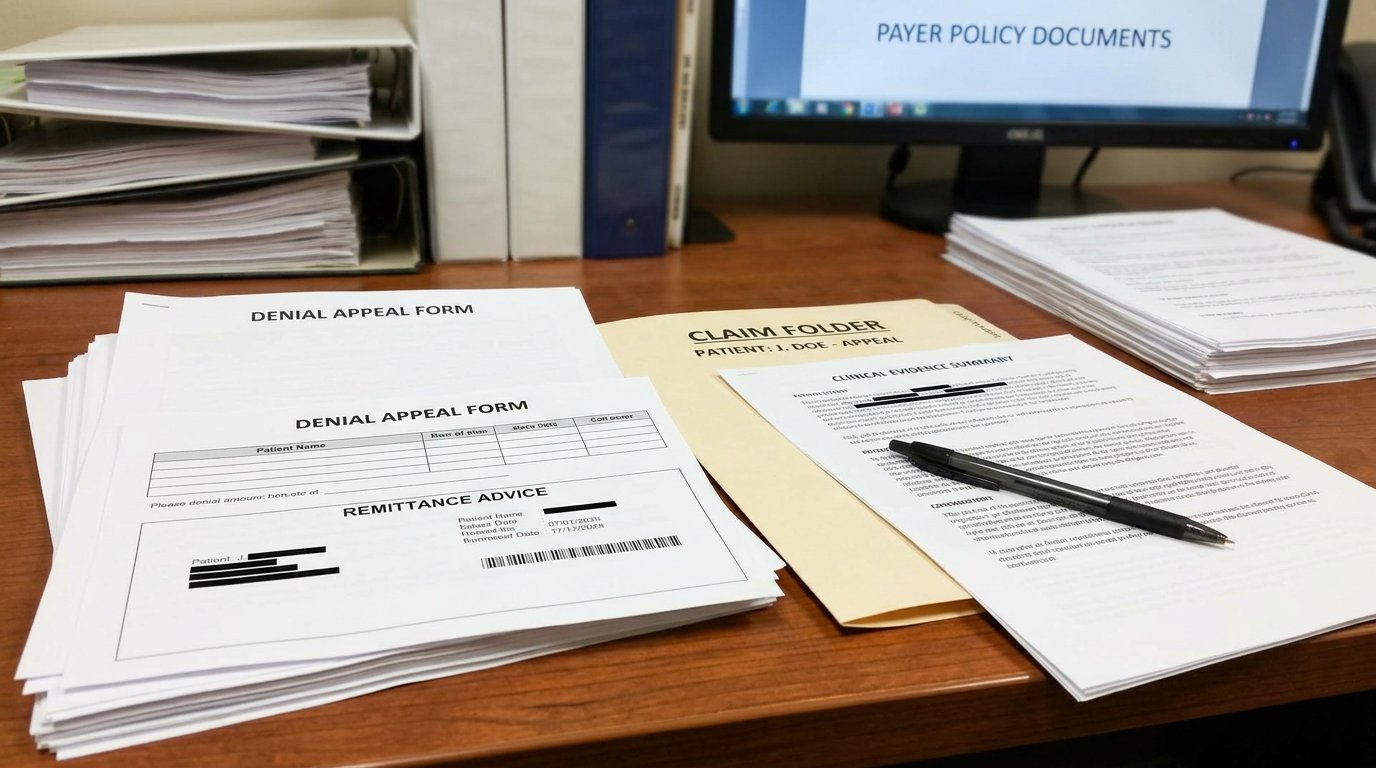


Medical record auditing in behavioral health identifies the documentation, coding, and credentialing breakdowns that cause 15, 25% revenue loss through claim denials. By reviewing session notes against time-based coding rules, payer requirements, and supervision protocols, you’ll catch errors before they trigger recoupments or audit penalties. Since two-thirds of denied claims are recoverable with timely action, internal audits aren’t optional, they’re your frontline revenue defense. Below, you’ll find the exact process to implement one.
Why Behavioral Health Practices Lose 15, 25% to Denials

When behavioral health practices lose 15, 25% of expected revenue to denials, the root cause is rarely a single billing error, it’s a pattern of breakdowns across authorization management, coding accuracy, credentialing maintenance, and appeal follow-through. Behavioral health denial rates run 50, 85% higher than other specialties, driven by strict payer rules around prior authorization, time-based CPT selection, and modifier alignment. Credentialing mismatches trigger automatic rejections before claims reach medical review. Yet practices appeal only 40, 50% of denials, despite overturn rates reaching 57, 82%. Each unappealed denial becomes a permanent write-off. Medical record auditing in behavioral health exposes these compounding failures before they erode revenue, giving you the documentation trail needed to prevent denials systematically rather than chasing them reactively. Most of this lost revenue stems from preventable workflow failures rather than actual coverage limitations, meaning internal audits targeting front-end processes can recapture the majority of what practices currently write off.
Documentation Gaps That Make BH Claims Non-Billable
Although payers deny behavioral health claims for many stated reasons, the underlying cause is almost always the same: the medical record doesn’t support what was billed. A behavioral health compliance audit consistently reveals the same failures: unspecified diagnoses like F32.9 instead of clinically precise codes, progress notes stating “patient doing well” without documenting interventions or treatment response, and missing golden thread connections between diagnosis, treatment plan, and session content. When you don’t document active comorbidity management, you forfeit CC/MCC designations that drive reimbursement. Inconsistent documentation methods across clinicians compound these gaps, creating records that can’t withstand payer scrutiny. As payer audits of behavioral health claims increase alongside expanded funding and value-based models, these documentation weaknesses invite even greater financial and regulatory exposure. Each gap represents a specific, preventable revenue loss, and a compliance exposure that grows with every unbilled or denied claim.
Time-Based Coding Errors That Trigger BH Denials

Time-based coding errors represent one of the most common, and most preventable, categories of behavioral health claim denials. When you bill 90834 without documenting at least 38 minutes of face-to-face psychotherapy, or round 37 minutes up to meet the threshold, payers flag the claim as upcoding. MR auditing in addiction treatment settings routinely uncovers these exact failures, vague time entries, missing start and end times, and non-billable activities inflating session duration.
You can’t count care coordination, administrative tasks, or prior-day chart review toward time-based psychotherapy codes. If you’re combining medication management with psychotherapy, you must separate and document each component’s time independently. Without precise timestamps and clinical justification linking time spent to specific interventions, your claims won’t survive payer scrutiny. Practices should conduct regular internal audits to catch these time-based documentation errors before claims submission rather than discovering them after denials have already impacted revenue.
Supervision and Credentialing Gaps That Create Audit Risk
Supervision and credentialing failures don’t just create compliance risk, they invalidate otherwise billable services. If a clinician’s license lapses or supervision documentation doesn’t exist, every claim tied to that provider becomes vulnerable to recoupment. In Medicaid settings especially, inadequate supervision protocols have triggered enforcement actions during audits.
A thorough behavioral health documentation audit should verify active licensure, DEA registrations, and documented supervisory oversight for all rendering providers. You can’t rely on memory-based workflows, formal protocols must capture supervision frequency, scope-of-practice adherence, and signoff records. OIG guidance requires monthly exclusion monitoring, and auditors expect documented proof of search details, timing, and corrective actions. Without these records, your audit preparation has a structural gap that no clinical documentation can close.
What a Behavioral Health Billing Audit Actually Reviews

Credentialing and supervision gaps represent one category of audit exposure, but a behavioral health billing audit covers far more ground than provider-level compliance. An internal audit behavioral health billing review evaluates whether every billed service holds up against documentation, coding rules, and payer requirements simultaneously. Auditor expectations in addiction billing are increasingly stringent, requiring providers to ensure full transparency and accuracy in their submissions. Compliance with these expectations helps to mitigate the risk of audits and potential denials.
A behavioral health billing audit tests every claim against documentation, coding rules, and payer requirements at once.
Your audit should systematically examine:
- Coding-to-documentation alignment, verifying that CPT codes match the service level, time statements, and clinical complexity reflected in the note.
- Medical necessity support, confirming that progress notes document specific interventions, client response, and ongoing clinical need rather than vague summaries.
- Claim completeness, validating demographics, diagnosis-to-procedure linking, authorization numbers, telehealth modifiers, and group size compliance against payer thresholds.
Each element carries distinct recoupment risk when deficient.
The 7-Phase Internal Audit Process for Behavioral Health
A structured internal audit program breaks down into seven distinct phases, each targeting a specific layer of compliance, documentation, and revenue risk.
You’ll start by defining objectives and scope, identifying high-risk areas like billing mismatches and treatment plan gaps. Phase two establishes standardized audit criteria aligned with CMS, HIPAA, and 42 CFR Part 2. Third, you’ll assemble your team and determine sampling methodology, typically 10, 20 charts quarterly.
During fieldwork, your clinical documentation audit reviews session timestamps, service categories, and billing code accuracy. Phase five analyzes findings, flagging red flags like missing units or inconsistent note formats. You’ll then report findings with actionable recommendations within four weeks. The final phase implements corrective actions and monitors ongoing compliance.
Pre-Claim vs. Post-Claim Audits: Which Catches More Revenue?
When you validate claims before submission, you’re catching documentation gaps, coding mismatches, and authorization failures at the point where correction costs you minutes instead of months, and where your clean claim rate directly determines how fast revenue converts to cash. When you audit post-claim, you’re shifting to a recovery posture, identifying denial patterns, recouping improper payments, and building the evidentiary record you need to win appeals against payer disputes. Both functions protect revenue, but they operate on fundamentally different timelines and risk profiles, and understanding where each delivers the highest return determines whether your audit program is truly optimized or leaving recoverable dollars on the table.
Pre-Claim Validation Benefits
Most behavioral health facilities treat auditing as a post-claim function, reviewing records after denials arrive, then scrambling to correct documentation gaps that have already cost them revenue. Pre-claim validation benefits your operation by catching those gaps before submission, not after. Behavioral health claim submission tips can significantly streamline your processes. Implementing these strategies early can reduce delays and costly errors.
When you build a behavioral health audit program around pre-claim validation, you gain three measurable advantages:
- Denial rate reduction, You verify coverage, eligibility, and authorization requirements before claims reach the payer, eliminating the most common rejection triggers.
- Cashflow acceleration, Provisional affirmations from payers give you payment assurance without the weeks-long delays of post-claim appeals.
- Administrative efficiency, Your staff spends less time on rework and more time supporting clinical operations.
Pre-claim validation doesn’t replace post-claim audits, it reduces your dependence on them.
Post-Claim Denial Recovery
Despite the proven advantages of pre-claim validation, post-claim denial recovery remains a non-negotiable component of any behavioral health audit program, because no front-end process catches everything. With nearly 20% of claims denied and 60% never resubmitted, you’re leaving recoverable revenue untouched without a structured post-claim process.
| Recovery Factor | Risk if Unmanaged | Action Required |
|---|---|---|
| Appeal deadlines | 30, 180 days; missed deadlines bar recovery permanently | Implement payer-specific tracking systems |
| Denial root causes | Recurring coding errors and documentation quality behavioral health gaps compound losses | Aggregate denial data by category for targeted correction |
| Evidence compilation | Weak rebuttals reduce overturn rates | Submit numbered exhibits with corrected clinical documentation |
Two-thirds of denied claims are recoverable, but only if you act within payer-imposed timelines.
How Behavioral Health Audits Prevent Recoupments and Fines
Because most recoupments stem from documentation gaps rather than inappropriate care, behavioral health facilities that lack an internal audit program are effectively gambling with their revenue. Audit recovery demands typically range from $30,000 to over $200,000, and facilities repay 40, 60% of initial demands even after appeals. Maintaining patient trust during collections is essential for the long-term sustainability of any healthcare facility. Facilities that prioritize transparency and communication can foster stronger relationships with their patients.
A structured record review behavioral health program prevents these losses by catching deficiencies before payers do. Specifically, internal audits:
- Identify coding-to-service misalignment where billed services aren’t adequately supported by clinical documentation.
- Flag medical necessity gaps in progress notes, treatment plans, and level-of-care justifications that trigger recoupment demands.
- Detect credential and supervision deficiencies that create compliance exposure across your entire claims history.
You can’t appeal what you don’t catch. Proactive auditing eliminates preventable financial risk.
How to Track Compliance After Your First BH Audit
Completing your first internal audit identifies where documentation gaps exist, but without a system to track whether those gaps actually get fixed, the audit itself has limited value. You need structured corrective action workflows that assign ownership, set deadlines, and verify resolution for every finding.
Implement real-time compliance dashboards through your EHR and billing software to monitor incomplete documentation, unsigned notes, and supervision gaps daily. Score recurring issues across providers as compliant, needs improvement, or non-compliant to prioritize interventions. Track staff training completion rates and schedule quarterly self-audits with standardized checklists.
Every mr audit strengthens revenue protection only when findings drive measurable change. Document corrective actions, forecast financial impact for risk-tiered deficiencies, and close each feedback loop before the next review cycle.
Call Now and Simplify Your Billing Process
Revenue challenges should never distract you from the work that matters most. At Arise Billing Solutions, our experienced U.S.-based team manages your entire billing cycle with accuracy, transparency, and integrity. Call +1 (747) 256-6600 today and let us help you take control of your revenue.
Frequently Asked Questions
How Often Should Behavioral Health Practices Conduct Internal Medical Record Audits?
You should conduct internal medical record audits at least annually, but behavioral health practices benefit most from a layered approach. Perform quarterly self-audits across documentation standards, monthly targeted reviews of 5, 10 records per provider for high-risk areas like telehealth, and increase frequency when error rates exceed 10% or regulatory changes occur. Re-audit corrected areas within 60, 90 days to confirm sustainable improvement and reduce compliance exposure.
Can Internal Audit Findings Be Used Against Us During External Payer Audits?
Yes, internal audit findings can surface during external payer audits, but that’s not a reason to avoid them. In fact, documented findings paired with corrective actions demonstrate compliance intent, which regulators view favorably. What creates real liability is *not* auditing and letting issues go unaddressed. If an external auditor uncovers problems you should’ve caught internally, you’ll face steeper penalties, recoupments, and potential fraud scrutiny.
Who Should Perform Internal Audits, Clinical Staff or Compliance Professionals?
You need both. Clinical staff review medical necessity, treatment plan alignment, and progress note quality, while compliance professionals verify billing accuracy, regulatory adherence, and documentation completeness. Separating these roles strengthens audit defensibility. You’ll also want auditors reporting independently to an audit committee, not operational management, to avoid conflicts of interest. Rotating auditors every three to five years and periodically engaging outside counsel further protect objectivity and reduce institutional blind spots.
What Sample Size of Records Is Sufficient for a Meaningful Audit?
You should audit a minimum of 30, 50 records per review cycle for routine process audits. For higher-risk areas or payer-specific compliance checks, increase your sample to 65 or more records at 95% confidence with a 5% tolerable exception rate. If your population exceeds 200 records, you’ll need proportionally larger samples. Even a single exception in a small sample can trigger a materiality assessment, so don’t undersize your audit.
How Long Should Behavioral Health Practices Retain Completed Internal Audit Documentation?
You should retain completed internal audit documentation for a minimum of six years under federal HIPAA requirements, but you’ll want to extend that to 10 years if you’re participating in Medicare managed care programs or need protection against False Claims Act liability. Don’t destroy any audit records during pending litigation or active investigations. Always check your state’s specific retention schedule, as it may impose longer requirements than federal minimums.