


Your clean claim rate measures the percentage of claims payers accept on the first submission, calculated as (first-pass accepted claims ÷ total claims submitted) × 100. It’s the most important metric in behavioral health billing because it captures every upstream breakdown, from eligibility gaps to coding mismatches, in a single number. The HFMA benchmark is 95%, and falling below it can expose thousands per million billed to costly rework. Below, you’ll find exactly how to close that gap.
What Is a Clean Claim Rate in Behavioral Health Billing?
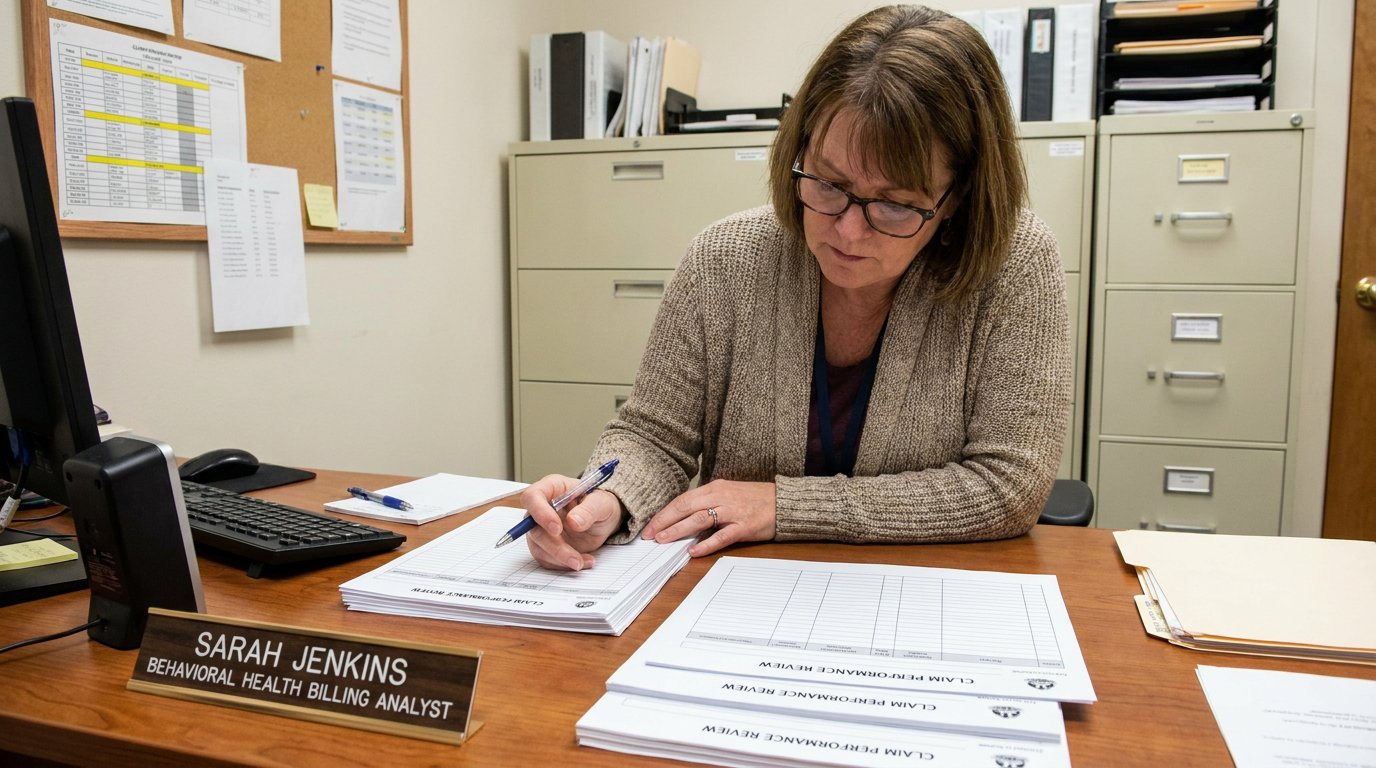
Clean claim rate measures the percentage of claims a payer accepts on the first submission, no corrections, no resubmission, no additional information requests. It’s the most direct indicator of whether your billing operation is functioning at a high level or hemorrhaging time and revenue through preventable errors.
Among behavioral health billing metrics, clean claim rate stands apart because it captures front-end accuracy, coding precision, and authorization compliance in a single number. Your claim acceptance rate behavioral health benchmark should target 90% or higher, though industry-leading operations push past 95%. The Healthcare Financial Management Association establishes 95% as the industry standard, making it the definitive benchmark against which every practice should measure performance.
If you’re tracking only one KPI across your revenue cycle, this is the one. It tells you exactly how much rework your team is creating before a single dollar posts.
How to Calculate Your Clean Claim Rate
The formula is straightforward: divide the number of claims accepted on first submission by the total number of claims submitted, then multiply by 100. Pull your data from clearinghouse reports, not your EHR, for the most accurate rejection counts. Your first pass rate behavioral health operations depend on reliable source data. Many rejections originate from simple formatting errors, such as dashes in patient names, which can be resolved quickly to boost your rate significantly.
| Metric | Facility A | Facility B |
|---|---|---|
| Claims Submitted | 4,500 | 552 |
| Rejected on First Pass | 450 | 13 |
| Clean Claim Rate | 90% | 98% |
Facility B’s clean claim rate demonstrates high-performing billing. Facility A sits below the 95% benchmark, meaning 450 claims require rework monthly. Run this calculation monthly and segment by payer to pinpoint where improving clean claim rate efforts should concentrate.
Why Clean Claim Rate Is Your Most Important Billing Metric
Knowing your number is only useful if you understand what it’s telling you about your operation’s financial health. Your clean claim rate functions as a diagnostic tool, it exposes breakdowns in eligibility verification, authorization tracking, coding accuracy, and documentation standards simultaneously.
Among behavioral health billing KPIs, no other single metric captures this breadth. Denial rate measures failures after the fact. Days in A/R measures consequences. Clean claim rate measures prevention. By the clean claim definition billing teams use operationally, every first-pass acceptance confirms your front-end processes are working. Every rejection identifies exactly where they’re not. Tracking and categorizing these rejection patterns allows teams to identify trends and integrate best practices into daily operations for long-term revenue cycle strength.
Each rejected claim costs approximately $25 to rework and delays payment by two to four weeks. That’s compounding revenue leakage you can measure and eliminate.
Clean Claim Rate Benchmarks for Behavioral Health
The Healthcare Financial Management Association sets the industry benchmark for clean claim rates at 95%, but most behavioral health practices operate between 75% and 85% due to the complexity of authorization requirements, medical necessity documentation, and payer-specific coding rules. You should target a minimum clean claim rate of 90% for your behavioral health facility, with anything below that threshold signaling significant revenue cycle dysfunction that demands immediate process correction. Understanding where your rate falls within these performance tiers, excellent at 95%+, acceptable at 90, 94%, and problematic below 90%, gives you a clear framework for measuring your billing operation’s effectiveness against industry standards.
Industry Performance Standards
Because clean claim rate directly governs how fast revenue converts from earned to collected, understanding where your facility falls against industry benchmarks isn’t optional, it’s the starting point for every meaningful billing improvement. The industry clean claim rate benchmark sits at 95% for solid behavioral health billing performance, with top-performing operations consistently hitting 97% or above through automated scrubbing and front-end verification protocols.
If your clean claim rate drops below 90%, you’re operating in a warning zone where revenue leakage compounds across every service line. Behavioral health claims face rejection rates 85% higher than standard medical claims, making precise benchmark tracking even more critical. You can’t improve what you don’t measure, and in behavioral health billing performance, measurement starts here. Quality control in behavioral health billing is essential to ensure that claims are processed efficiently and accurately. This emphasis on quality can significantly reduce the likelihood of denials and delays in payment.
Behavioral Health Targets
While the 95% industry benchmark set by HFMA and MGMA applies broadly across healthcare, behavioral health facilities face a steeper climb to reach it, most practices currently operate between 75% and 85%, well below the standard that prevents meaningful revenue leakage. Behavioral health denial rates run 85% higher than medical claims despite parity laws, making clean claim rate behavioral health’s most critical performance indicator.
Understanding what is clean claim rate and where your facility falls against these benchmarks determines your improvement trajectory. You should target 90% or higher as your operational baseline, with 93%+ representing proven achievability through experienced billing processes. Daily monitoring helps you identify trending errors before they compound. Pairing a 95%+ clean claim rate with denial rates below 5% drives prime revenue cycle performance.
Why Behavioral Health Claims Get Rejected More Often

Behavioral health claims face higher rejection rates than most other medical specialties, not because the services lack legitimacy, but because the billing requirements are more layered and the documentation standards more subjective. You’re steering through prior authorization requirements across IOPs, residential, PHPs, and outpatient therapy, each with distinct concurrent review thresholds. Medical necessity determinations hinge on subjective clinical criteria, making denials harder to predict and prevent. Implementing best practices for claim management can significantly reduce the likelihood of denials in behavioral health. By ensuring that all documentation is meticulously prepared and aligned with the specific requirements, providers can enhance their claim acceptance rates.
Coding errors compound the problem. A mismatched diagnosis-procedure pair, like billing 90837 with Z63.0, triggers automatic rejections. Missing F-codes, exceeded unit limits, and payer-specific coding rules create additional failure points. Layer in eligibility verification gaps, timely filing deadlines, and documentation that lacks individualized treatment goals or measurable progress, and you’ve got a rejection rate that compounds quickly without structured prevention protocols.
Five Front-End Failures That Tank Your Clean Claim Rate
Most of those rejections don’t originate in the back end, they’re baked into the claim before it ever reaches a biller’s queue. Front-end breakdowns account for the majority of first-submission failures, and each one is preventable.
| Front-End Failure | Impact |
|---|---|
| Incomplete or inaccurate patient data | 45% of denials trace to missing or wrong information |
| Missing prior authorization | Leading cause of mental health claim rejections |
| Inadequate eligibility verification | Single intake-only checks miss mid-cycle benefit changes |
| Insufficient clinical documentation | Weak notes trigger retro-denials across entire treatment episodes |
You’ll notice coding errors aren’t listed here, they’re mid-cycle failures. These four front-end breakdowns compound before claims ever reach coding, making downstream accuracy nearly impossible.
The Hidden Revenue Drain of a Low Clean Claim Rate
When your clean claim rate drops below the 95% benchmark, the financial damage extends far beyond the obvious rejected claims, rework costs escalate rapidly, with claims adjudication processes costing providers over $25.7 billion annually in denial handling and resubmissions alone. Each claim that cycles back through correction and resubmission delays your reimbursement timeline, destabilizing cash flow and inflating your days in accounts receivable while up to 65% of denied claims are never resubmitted at all. The compounding pressure of chronic rework doesn’t just drain revenue, it drives billing staff burnout and turnover, further degrading your team’s capacity to prevent the very errors causing the problem.
Rework Costs Add Up
Every denied claim costs money before it ever returns a dollar. The average behavioral health claim rework costs $62.40 in administrative labor, and that’s against an average outpatient therapy reimbursement of just $115. That means 54% of the claim’s value disappears into rework before you collect anything.
Simpler fixes like coding corrections run $25 to $35 per claim. Complex appeals requiring additional clinical documentation can reach $118. When your denial rate sits at 20%, you’re exposing $200,000 per $1M billed to these costs.
The compounding effect is what damages your operation. Your billers spend disproportionate time chasing denied claims instead of processing new ones. Each rework cycle delays cash flow, inflates your fully loaded biller costs, and increases the probability of timely filing write-offs on otherwise valid claims.
Cash Flow Delays Compound
Because denied claims don’t just cost money to rework, they delay the payment you’ve already earned, a low clean claim rate creates a compounding cash flow problem that hits behavioral health practices harder than almost any other specialty.
| Impact Area | At 95% Clean Rate | At 85% Clean Rate |
|---|---|---|
| Claims requiring rework per 100 | 5 | 15 |
| Average payment delay per rework | 30, 45 days | 30, 45 days |
| Monthly revenue at risk | ~5% | ~15% |
| AR days increase | Minimal | Significant |
| Filing deadline exposure | Low | High |
You’re operating on thin margins. When 15% of your claims sit in rework queues, you’re funding payroll and operations without the revenue you’ve already earned. Each delayed claim extends your AR days and increases your exposure to missed filing deadlines, converting temporary delays into permanent write-offs.
Staff Burnout Increases Turnover
The financial damage from a low clean claim rate extends beyond delayed payments and write-offs, it erodes your billing team from the inside. When claims require constant rework, your staff absorbs repetitive manual reviews, payer rule changes, and documentation burdens that exceed standard capacity. That’s why 61% of providers identify administrative overload as their top burnout cause, with 93% of behavioral health workers reporting burnout. Behavioral health billing documentation are often overlooked, yet they play a crucial role in ensuring the efficiency of the financial processes.
The downstream impact is measurable. Behavioral health turnover rates range 40, 70%, with each exit costing $4,000, $7,600 in recruitment and training. When experienced billers leave, remaining staff inherit heavier workloads, driving further attrition. You lose institutional knowledge that’s critical for accurate claim submission, which pushes your clean claim rate even lower, creating a self-reinforcing cycle that compounds revenue loss at every stage.
How to Push Your Clean Claim Rate Above 95
Achieving a clean claim rate above 95% isn’t a single fix, it’s the result of tightening every stage of the billing cycle so errors don’t survive long enough to reach the payer.
- Verify eligibility and obtain authorizations before service. Confirm active coverage at least two days out and secure prior authorizations three to five days before the date of service. This eliminates the two most common denial categories at intake.
- Run every claim through a scrubbing engine. Flag modifier errors, diagnosis-procedure mismatches, and place-of-service inconsistencies before submission.
- Audit denied claims weekly. Track denial reason codes, identify patterns, and update front-end workflows to prevent recurrence. You can’t improve what you don’t measure.
Billing KPIs to Track Beyond Clean Claim Rate
While clean claim rate tells you how accurately your facility submits claims on the first pass, it doesn’t capture the full picture of revenue cycle health. You need five additional KPIs working alongside it.
Days in A/R measures how long claims remain unpaid. Target below 40 days and monitor aging buckets beyond 90 days weekly. Denial rate should stay below 5%, analyze by payer and reason code for targeted fixes. Net collection rate reveals what percentage of collectible revenue you’re actually receiving; benchmark 95% or higher. First pass resolution rate tracks how effectively you overturn denials on a single appeal, targeting 95%. Average reimbursement per claim identifies month-over-month payer performance shifts and coding issues affecting profitability. Track all six metrics together for complete revenue cycle visibility.
Call Now and Simplify Your Billing Process
Revenue challenges should never distract you from the work that matters most. At Arise Billing Solutions, our experienced U.S.-based team manages your entire billing cycle with accuracy, transparency, and integrity. Call +1 (747) 256-6600 today and let us help you take control of your revenue.
Frequently Asked Questions
How Often Should a Behavioral Health Facility Audit Its Clean Claim Rate?
You should monitor your clean claim rate daily through your billing dashboard, conduct detailed analyses weekly, and perform thorough audits monthly. Daily tracking catches submission errors in real time. Weekly reviews let you identify payer-specific rejection patterns and coding accuracy trends before they compound. Monthly audits compare your performance against the 90, 95% benchmark and inform targeted training. This layered approach keeps your rate above 90% and prevents revenue loss.
Can Switching Clearinghouses Improve Your Clean Claim Rate Significantly?
Switching clearinghouses can improve your clean claim rate, but only if your rejections stem from submission errors, formatting failures, or lack of behavioral health, specific validation. You should analyze your rejection reason codes first, if most denials trace back to upstream issues like incomplete eligibility verification, missing authorizations, or coding errors at intake, a new clearinghouse won’t fix those problems. Address root causes before assuming the clearinghouse is your bottleneck.
Does Outsourcing Behavioral Health Billing Guarantee a Higher Clean Claim Rate?
Outsourcing doesn’t guarantee a higher clean claim rate, but it considerably increases your odds. Specialized behavioral health billing teams consistently achieve 98% clean claim rates compared to the 80% average you’ll see with internal departments. You’re gaining dedicated expertise in authorization management, payer-specific compliance, and mental health coding requirements. You’ll also eliminate the institutional knowledge loss from the 32% staff turnover rate that plagues in-house billing operations.
How Long Does It Take to Improve a Poor Clean Claim Rate?
You’ll typically see initial improvements within 30, 60 days once you implement daily monitoring, eligibility verification, and authorization tracking. Most behavioral health practices reach a 90% clean claim rate within 90, 120 days and hit the 95%+ benchmark in four to six months. The timeline depends on your starting point, moving from below 75% to above 85% usually takes three to five months of consistent process corrections and staff training.
What Technology Tools Best Help Maintain a High Clean Claim Rate?
You’ll get the most impact from integrated EHR-to-billing systems that auto-populate encounter data, AI-powered code suggestion engines that analyze clinician notes against payer trends, and payer-specific claim scrubbing tools that catch modifier, authorization, and diagnosis-pairing errors before submission. Real-time denial analytics dashboards let you track rejection patterns by payer and service type, so you’re correcting root causes proactively rather than chasing rework after the fact.