



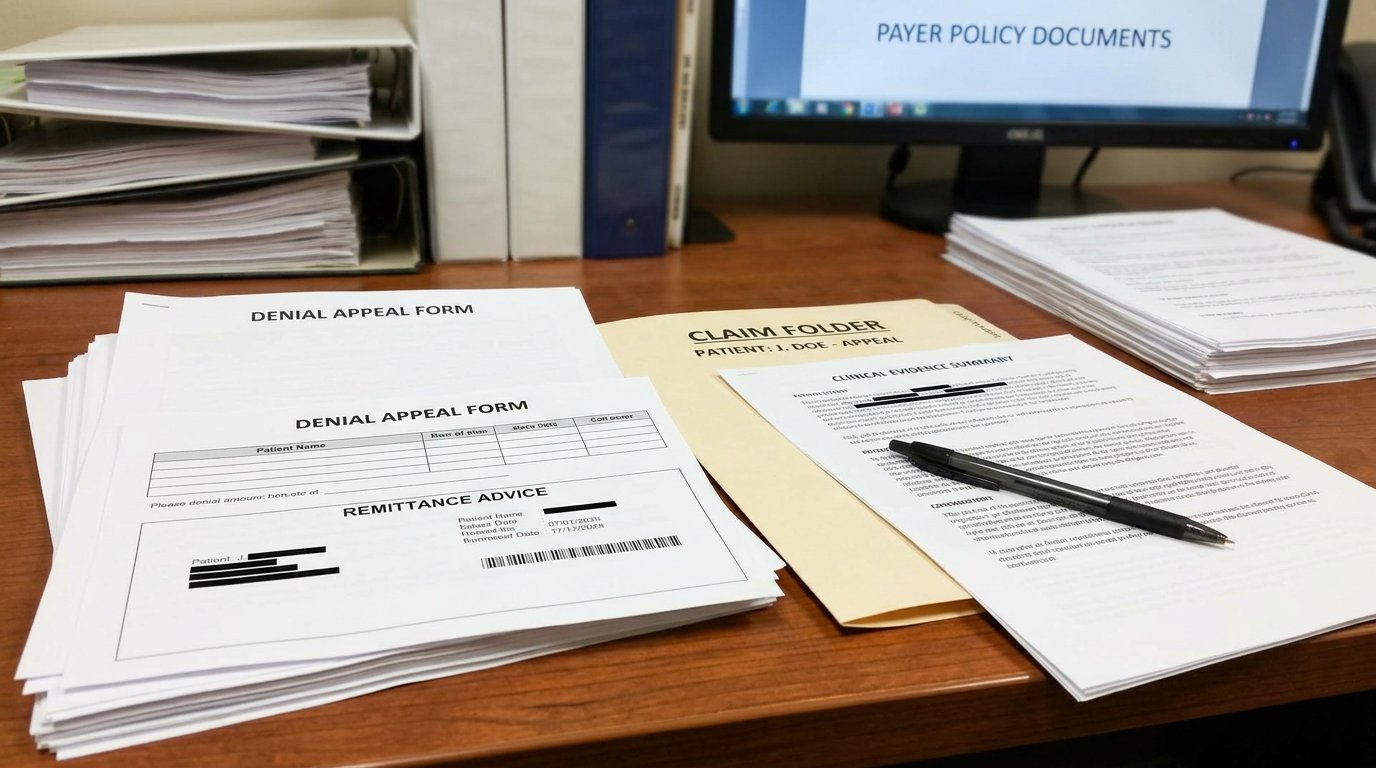


To document medical necessity so payers can’t deny your behavioral health claims, you’ll need to link every session note to a DSM-5 diagnosis, track measurable treatment goals with standardized tools like the PHQ-9 or GAD-7, and document functional impairments with concrete examples. Each note must independently justify the billed service and provide clinical rationale for continued care. Below, you’ll find the specific strategies that close the documentation gaps payers look for.
What Medical Necessity Means in Behavioral Health

Medical necessity isn’t a clinical concept, it’s a contractual one. It’s the standard your payer applies to decide whether a service warrants reimbursement. In behavioral health, that standard requires you to demonstrate that each service is clinically appropriate in type, frequency, and duration for your patient’s specific condition, and that no equally effective, less costly alternative exists.
Every payer applies its own medical necessity criteria behavioral health framework. Some use MCG guidelines, others use InterQual, and some layer both sequentially. California defines it through peer-reviewed studies and clinical guidelines. Michigan ties it to evidence-based interventions. What’s consistent across all frameworks: you must document why this patient needed this service, at this intensity, right now, or the claim gets denied. At the federal level, CMS sets the standards and ensures compliance with regulations that ultimately govern how medical necessity is defined and enforced across healthcare programs.
Tie Every Session to a DSM-5 Diagnosis
Before a payer evaluates whether your service was appropriate, it checks whether you’ve tied that service to a recognized clinical condition. Every progress note must connect your intervention directly to a DSM-5 diagnosis. Without this link, your medical necessity documentation mental health standards collapse. Accurate diagnosis requires careful attention because symptom overlap across DSM-5-TR® categories makes it essential to clearly justify why one condition was identified over another.
To anchor each session to a diagnosis:
- Identify the DSM-5 disorder on the first session using code 90791, even if the diagnosis is tentative
- Link each intervention to specific symptom clusters or diagnostic criteria you’re actively treating
- Document functional impairment in work, relationships, or daily living tied to the diagnosis
- Record symptom progression showing how the condition justifies continued treatment
- Specify your clinical rationale for why chosen interventions target that disorder’s elements
Build Medical Necessity Goals Payers Can Measure

Payers won’t authorize treatment tied to vague objectives, you need goals built on measurable treatment outcomes that specify the behavior, the criteria for mastery, and the timeline for reassessment. Each goal must align directly with the patient’s DSM-5 diagnosis and document how the targeted behavior reflects a functional impairment caused by that diagnosis. You’ll also need to track objective progress data at regular intervals, using quantifiable metrics that show whether the patient is advancing toward defined benchmarks or requires a modified treatment approach. When claims lack this level of specificity, they are subject to automated denial through claim edits that most payers use to verify whether procedure codes appropriately match the patient’s diagnosis codes.
Define Measurable Treatment Outcomes
When a payer reviews clinical documentation for medical necessity, they’re looking for one thing above all else: measurable evidence that treatment is producing clinical benefit. Meeting medical necessity billing standards requires you to define outcomes payers can objectively verify.
Track these five outcome categories consistently:
- Standardized symptom scales, Administer PHQ-9, GAD-7, or equivalent tools at baseline and regular intervals to quantify symptom change
- Functional benchmarks, Document return to work, school attendance, or ADL restoration as concrete treatment impact
- Behavioral frequency data, Track specific symptom manifestations and their measurable reduction over time
- Health behavior indicators, Record sleep quality, appetite, energy levels, and substance use changes
- Quality of life metrics, Measure social re-engagement, relationship improvement, and adaptive coping skill development across settings
Align Goals With Diagnosis
Every goal in a treatment plan must trace directly back to the patient’s DSM-5-TR diagnosis, because if a payer can’t see the link between the diagnostic criteria, the presenting symptoms, and the treatment objective, they’ll deny the claim. This alignment is the core defense against a medical necessity denial behavioral health providers face during utilization review. Benefit verification for treatment centers is essential to ensure that all aspects of care are covered. Accurate documentation and adherence to treatment guidelines can significantly enhance the chances of approval
| Diagnosis | Presenting Symptom | Aligned Goal |
|---|---|---|
| Bipolar I Disorder | Manic episodes disrupting occupational functioning | Reduce manic symptom severity using GOALS intervention within 8 weeks |
| Adjustment Disorder | Passive suicidal ideation following job loss | Develop and review safety plan collaboratively within first two sessions |
| MDD, Recurrent | Anhedonia limiting daily activity | Increase participation in pleasurable activities to three per week within 30 days |
Collaborate with patients during goal-setting to strengthen engagement and produce payer-defensible, diagnosis-driven treatment objectives.
Track Objective Progress Data
Medical necessity claims survive payer scrutiny only when you back them with objective, measurable data, not clinical impressions alone. When documenting medical necessity addiction treatment, you need quantifiable benchmarks that show trajectory over time.
- Administer PHQ-9 and GAD-7 at every session, declining scores give payers concrete evidence that treatment is working and remains necessary.
- Collect baseline behavioral tracking logs for one week before intervention, then compare weekly to demonstrate measurable change.
- Use the OQ-45 or Sheehan Disability Scale to capture functional limitations alongside symptom severity.
- Track personalized metrics like employment stability, substance use frequency, or social engagement tied directly to treatment goals.
- Automate outcome tracking through your EHR to guarantee consistent measurement intervals that withstand payer audits.
Write Notes That Prove Medical Necessity Under Audit

Because payers and auditors evaluate each note as a standalone document, your clinical documentation must independently justify the service billed, without relying on context from prior sessions, treatment plans stored elsewhere, or institutional knowledge that doesn’t appear on the page.
Each note should document behavioral observations rather than clinical conclusions, name specific interventions tied to treatment plan goals, and quantify functional impairment with concrete examples. Record the client’s in-session response, skill acquisition, resistance patterns, or demonstrated insight, as direct evidence of active treatment.
When progress stalls, document why continued treatment remains appropriate. This clinical rationale is exactly what survives a medical necessity appeal behavioral health payers initiate. Notes lacking this specificity create the documentation gaps that trigger denials. Prior authorization strategies for behavioral health can help streamline the approval process and reduce delays in care. Implementing these strategies ensures that clinicians have the necessary support to advocate.
Prevent the Most Common Medical Necessity Denials
- Quantify symptom severity, document frequency, duration, and intensity using validated scales like PHQ-9 or PCL-5 instead of subjective descriptors.
- Link functional impairment to diagnosis, specify how symptoms disrupt work, relationships, or daily living.
- Justify your level of care, explain why a lower intensity won’t suffice.
- Document progress or clinical barriers, every note must show movement toward measurable goals or articulate why progress has stalled.
- Obtain preauthorization before delivering services, missing authorizations compound medical necessity disputes.
Maintain Medical Necessity Throughout the Course of Care
Establishing medical necessity at intake doesn’t satisfy payer requirements for the duration of treatment, every session note must independently justify why the patient still needs this service, at this level of care, at this frequency. Reference your treatment plan in each note, indicating progress, plateau, or regression toward specific goals. Payerspecific rules in behavioral health can vary significantly between different insurance providers, adding complexity to treatment planning.
Use standardized measures like PHQ-9 scores to quantify symptom severity and connect persistent symptoms to functional impairment, workplace performance, relationships, daily functioning. When progress stalls, document your clinical rationale for maintaining the current level of care medical necessity, including deterioration risk without continued sessions.
Each note should stand alone: current symptoms, interventions delivered, client response, and an updated plan with session frequency, homework, or treatment modifications. This structure protects every claim individually.
Call Now and Simplify Your Billing Process
Revenue challenges should never distract you from the work that matters most. At Arise Billing Solutions, our experienced U.S.-based team manages your entire billing cycle with accuracy, transparency, and integrity. Call +1 (747) 256-6600 today and let us help you take control of your revenue.
Frequently Asked Questions
Which Specific Payer Clinical Criteria Like Milliman or Interqual Apply to My Claims?
The criteria applied to your claims depend on your payer. Most payers use Milliman Care Guidelines (MCG) for outpatient behavioral health, including Wellcare, PacificSource, Evernorth, and Carelon. Some plans default to InterQual for non-substance use levels of care. For substance use claims, you’ll typically face ASAM criteria. Carelon follows a hierarchy: custom state criteria first, then ASAM, InterQual, and national guidelines. You should verify directly with each payer’s provider manual.
How Do I Appeal a Medical Necessity Denial After the Service Is Already Billed?
You’ll start by reviewing the denial letter to identify the exact clinical criteria the payer applied. Then, gather your clinical documentation, progress notes, treatment plans, and functional assessments, and obtain a letter of medical necessity from the treating provider. Submit your internal appeal within the payer’s deadline, addressing each denial rationale directly with supporting evidence. If denied again, escalate to an external independent review or file a complaint with your state insurance commissioner.
Does Medical Necessity Documentation Differ Between Medicaid and Commercial Insurance Payers?
Yes, it differs greatly. Medicaid requires state-specific forms, ownership disclosures, and justification aligned with CMS standards, while commercial payers like Aetna and Cigna apply their own coverage policies and evidence-based criteria such as Milliman or InterQual. You’ll need to tailor your documentation to each payer’s unique requirements. Both demand diagnosis-driven clinical justification, but Medicaid applies deeper compliance scrutiny, and commercial insurers emphasize insurer-specific verification standards you can’t interchange.
Can Telehealth Sessions Satisfy Medical Necessity Requirements the Same as In-Person Visits?
Yes, telehealth sessions can satisfy medical necessity requirements equally, but you’ll need to meet specific documentation standards. You must document clinical justification for telehealth over in-person care, guarantee active patient participation via real-time audio/video, and maintain records matching in-person quality. For Medicare, you’re required to complete an in-person visit within six months before initiating telehealth and annually thereafter. Don’t forget annual written telehealth consent covering risks, privacy, and alternatives.
How Long Should I Retain Medical Necessity Documentation to Comply With Audit Timelines?
You should retain medical necessity documentation for at least 10 years to cover the longest applicable audit window. CMS requires 7 years for standard Medicare records, but Medicare Advantage and Part D contracts extend that to 10 years. State laws and payer agreements can push timelines even further. Don’t destroy records during active audits or appeals. Store HIPAA compliance documents separately from clinical records so you can retrieve either quickly when auditors request them.